← Back to Articles
Solar & Nuclear Physics
Okay, But How Does Light Actually Come Out of the Sun?
Aug 2026•6 min read•By Chetraj Jaishi
Solar PhysicsNuclear FusionPlasmaPhotonsThermodynamics
“Examining how nuclear fusion in the solar core converts mass into energy via the proton-proton chain, and how radiative transfer, thermal bremsstrahlung, and atomic transitions transport photons outward to the photosphere.”
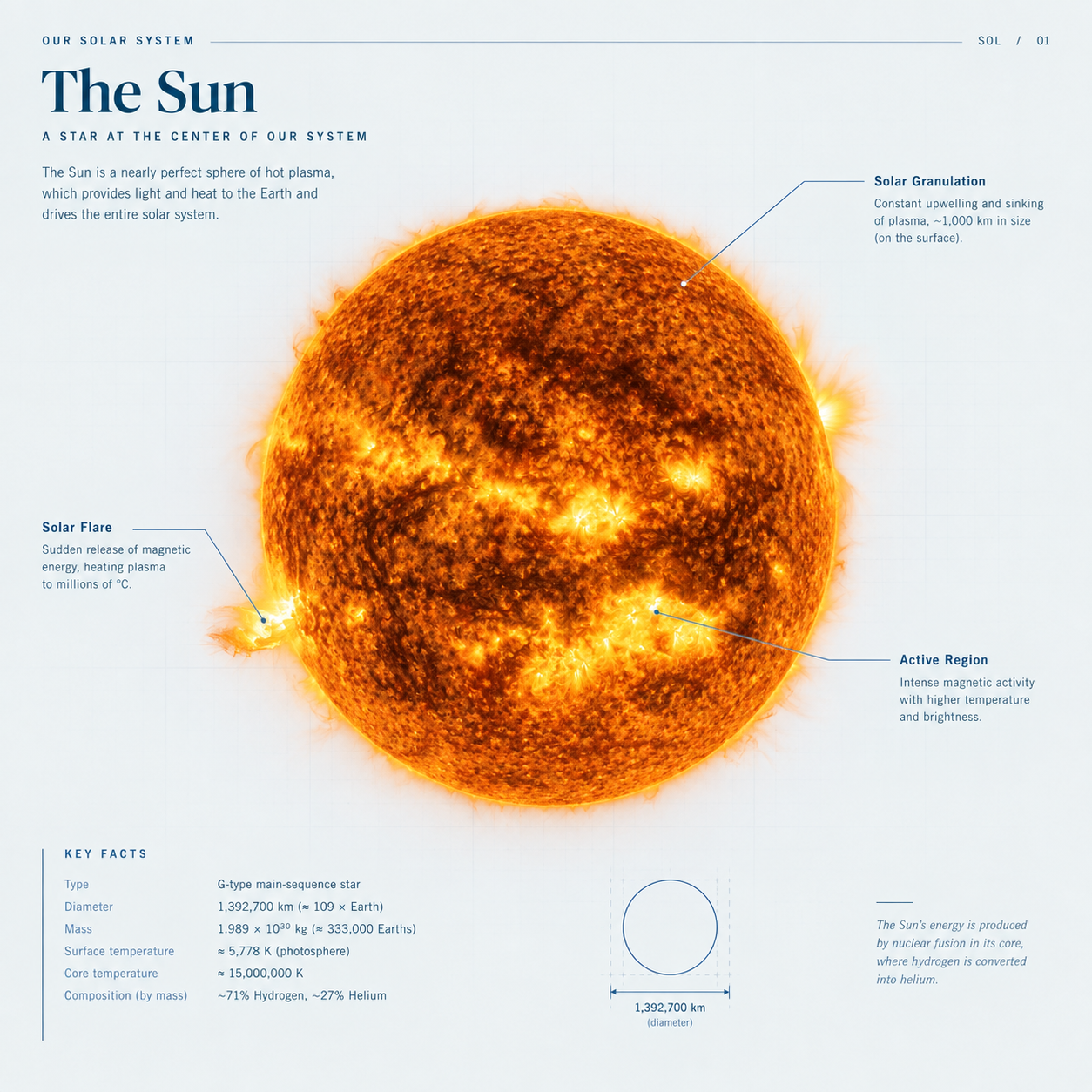
The sun is made out of hydrogen and helium. State? Plasma. Not liquid, not solid (cuz' at millions of °C, no liquid, no solid, not even gas can exist). It's a fourth state called plasma (ionized gas). At the core, electrons are completely stripped off atoms (not bound, moving freely at extremely high speeds) due to the high temperature. Atomic nuclei and electrons move independently of each other.
The fuel is hydrogen, helium is the product (not a reactant; this is nuclear fusion). In the core, gravity creates immense heat (~15M°C) and pressure, turning hydrogen into plasma. As stripped-off electrons leave behind positive protons, these protons move so fast from the extreme heat that they collide and merge. Four hydrogen nuclei (protons) convert into one helium-4 nucleus.
The resulting helium nucleus has slightly less mass than the original four protons. This missing mass converts into energy (heat and light).
In more depth:
When two protons fuse, one of them transforms (a proton converts into a neutron). This releases a positron (+e) and a neutrino (massless, neutral subatomic particles that interact only via the weak force, letting trillions of them pass through the human body every second), resulting in deuterium (a nucleus with one proton and one neutron).
Deuterium then fuses to form helium-3 (two protons, one neutron), releasing a gamma-ray photon in the process. Two helium-3 nuclei then fuse to form helium-4 (two protons, two neutrons), releasing two protons back.
Net result: 4 hydrogen nuclei → 1 helium-4 nucleus + energy
Each second, the sun converts approximately 4 million tonnes of mass into energy. Deep in the sun's core, roughly 600 million tonnes of H₂ fuse into roughly 596 million tonnes of He every second. The missing 4 million tonnes of mass convert into pure energy in the form of light and heat (E=mc²).
The sun loses approximately 5.5 million tonnes (4.3 × 10⁹ kg) of mass every second. Over its 4.6-billion-year history, it has lost only about 0.03–0.05% of its original mass. This gradual mass loss slightly weakens the sun's gravitational pull, causing Earth's orbit to expand outward by about 1.5 cm per year.
Why photons, why not electrons and protons?
Cuz' the sun has enormous gravity (escape velocity is 620 km/s), and protons and electrons stay trapped, colliding and scattering, nothing more. Also, electrons and protons carry electric charge, which interacts with plasma and nuclear forces. They can't escape as radiation can.
When charged particles (protons, electrons) accelerate, change speed, or change energy state, they emit electromagnetic radiation: photons.
Mechanisms:
1) Gamma emissionWhen deuterium fuses with a proton to form He-3, the binding energy is released as a high-energy gamma-ray photon. (Binding energy = the minimum energy required to disassemble a bound system, like an atomic nucleus, into its individual separated components (protons and neutrons).)
2) Thermal / blackbody radiationAny charged particle that accelerates emits radiation (called bremsstrahlung, "braking radiation"). Plasma is made of positive ions (atoms that lost electrons) and stripped-away, negatively charged electrons.
The electrons in the plasma are constantly accelerated or deflected by the electromagnetic field of the ions, and each deflection emits a photon. The hotter the plasma, the more violent the accelerations, the higher the energy of the photons emitted.
3) Atomic transitionsAs photons travel outward from the core, through the radiative zone and convective zone, toward the surface (photosphere), a photon interacting with an atom can be absorbed if its energy matches the gap between two electron energy levels. The electron jumps to a higher state, then almost instantly falls back down, re-emitting a photon. The re-emitted photon isn't always released in the same direction as the original, which causes light to scatter. This happens trillions of times per second (it's the process that shapes the sun's spectrum).
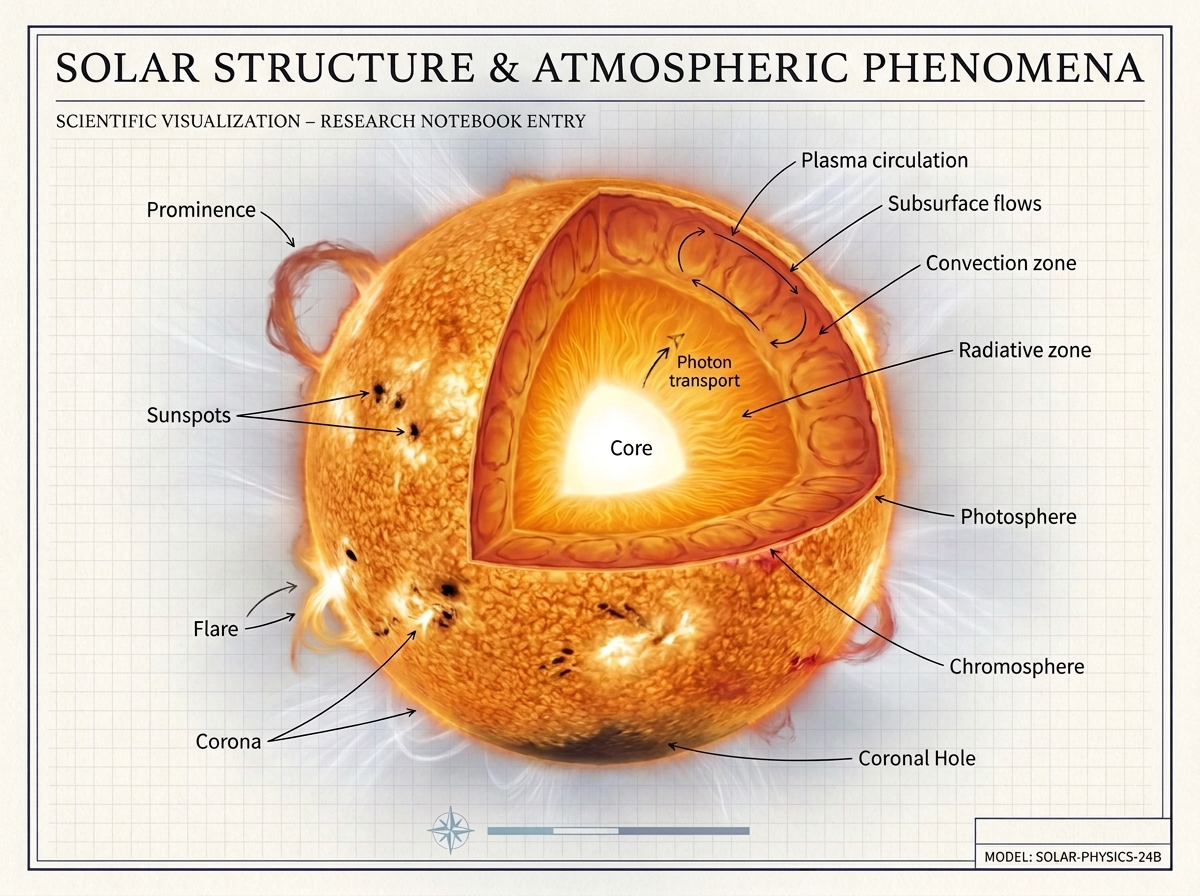
The sun's surface temperature is ~5500°C at the photosphere, determined by the balance between the inward force (gravity pulling all layers in) and outward radiation pressure. When these balance, the sun is in hydrostatic equilibrium. The surface temperature is specifically the temperature at which the photosphere becomes transparent enough for photons to escape freely (below this depth, photons are trapped and re-emitted; above it, they fly free).
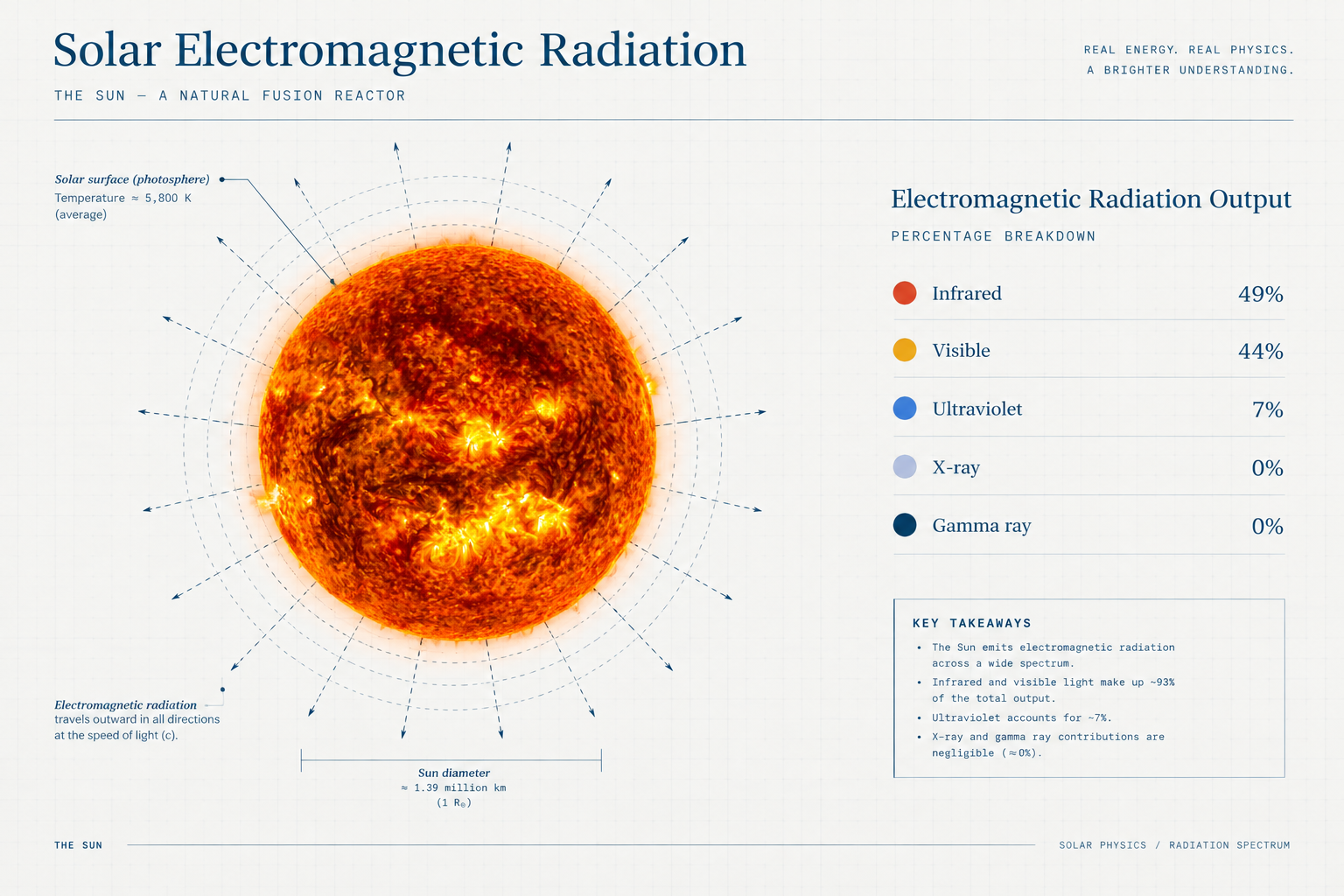
The sun emits photons uniformly in all directions (isotropic), but but but we only observe the photons coming toward us. Since re-emission takes thousands of years before a photon reaches the photosphere, and each re-emission happens in a random direction, it's not fully isotropic in real, practical terms. Energy is conserved, but it's spread across many photons of visible light, infrared, and ultraviolet.
[estimated, not proven/seen] (so nearly half the sun's energy arriving at Earth is infrared (heat radiation)).
Old Tungsten Filament Bulb
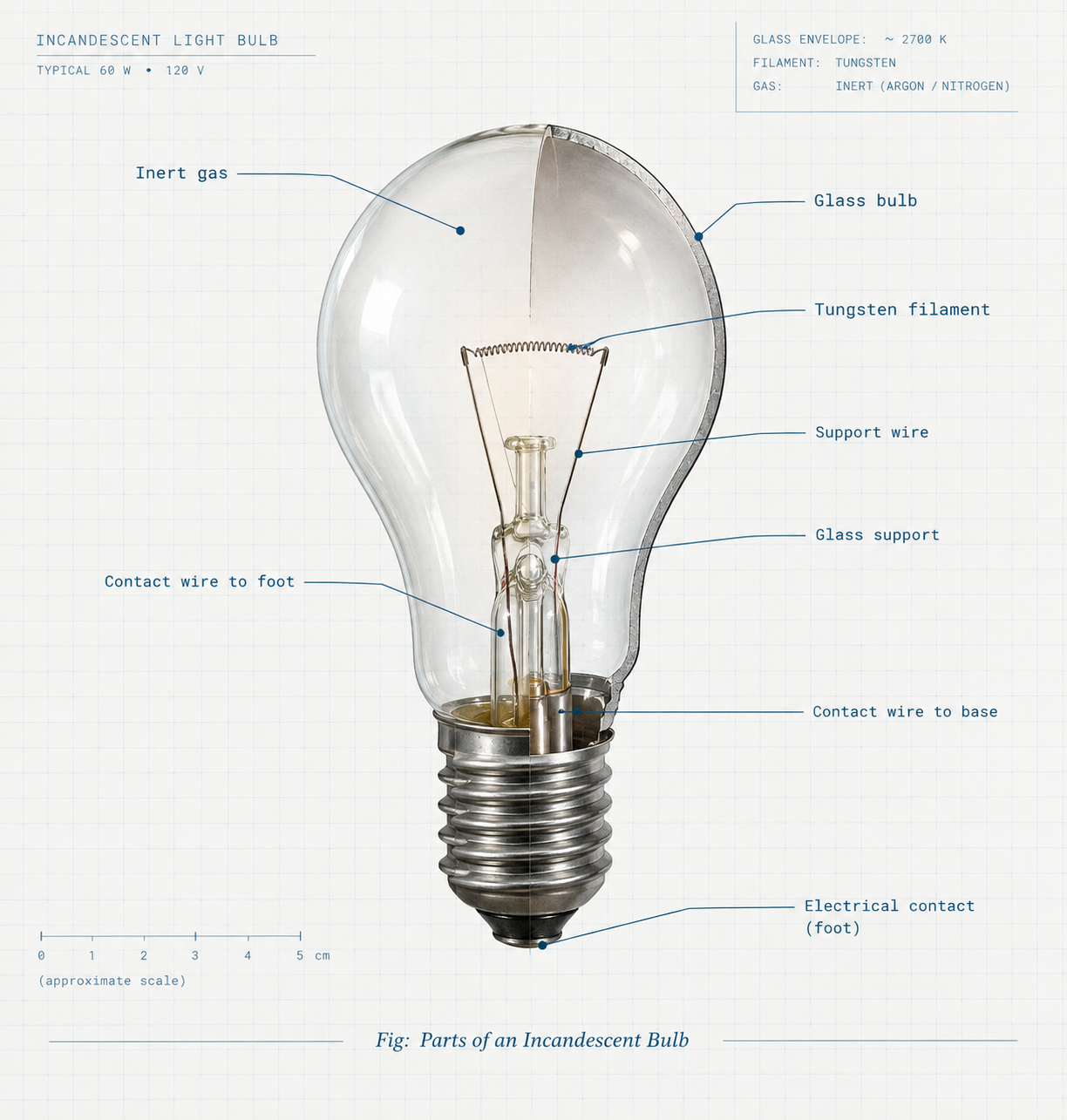
Tungsten: when electrical current flows through the wire and reaches the tungsten, its high resistance restricts electron flow, so electrons collide and produce thermal energy. This pushes the tungsten's temperature to ~2500°C (at that extreme temperature, atoms get excited and release energy as light/photons (white-hot light)). Like the sun, it emits photons across many wavelengths.
• 5% of electrical energy → visible light
• 95% of electrical energy → infrared heat
LED Room Light
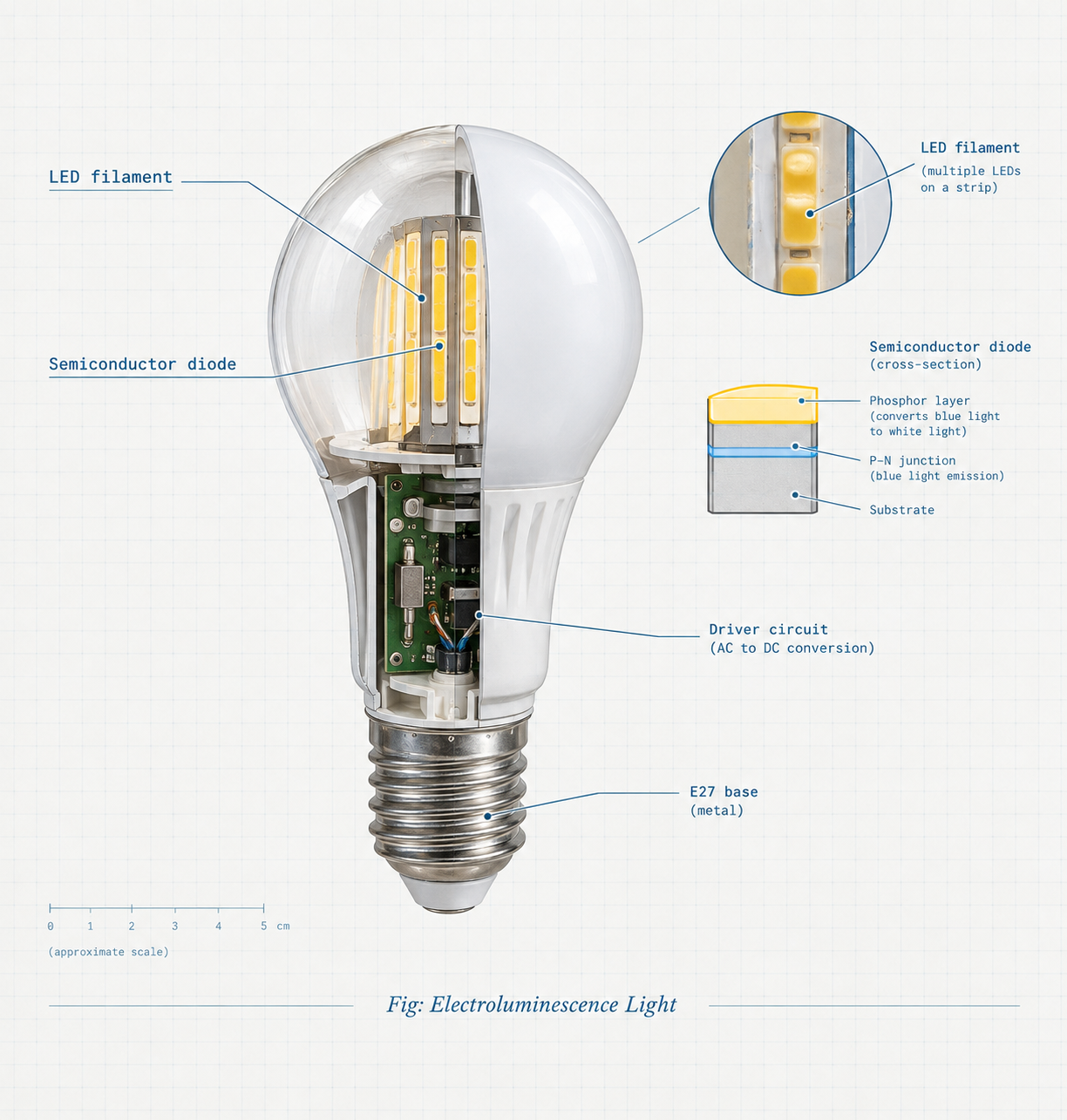
LED bulbs work via electroluminescence (producing light by passing electricity through a semiconductor material rather than heating a filament).